
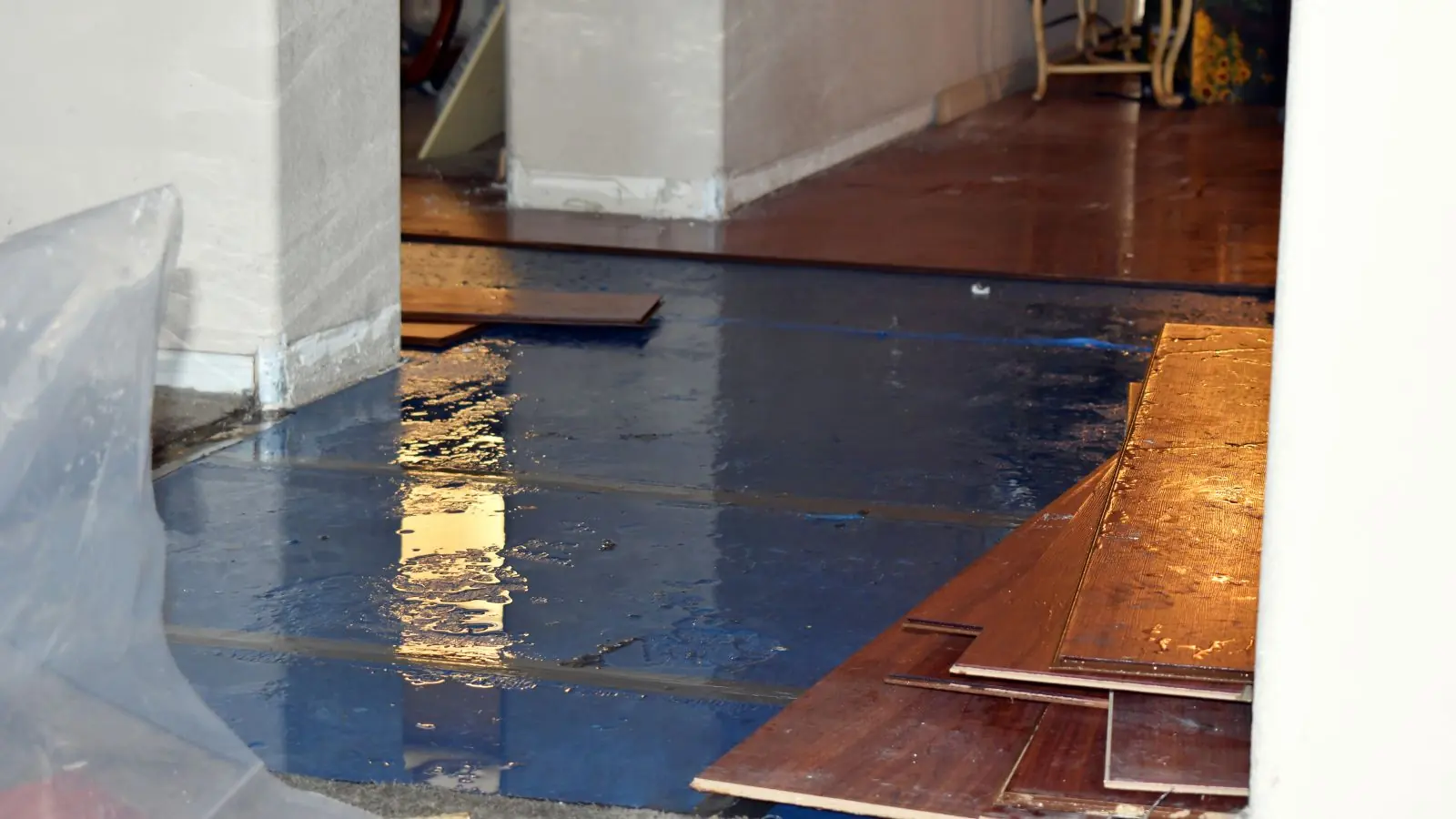
Dry first, then choose the repair
Repair decisions start only after drying is finished and the moisture readings have stopped moving. If your floor is still wet or still cupping, the steps for those first hours belong to the drying stage, not here. This page is about what happens after, when you are looking at boards that dried but did not look the same.
In short, a floor that dried flat with surface stain or dull finish usually gets sanded and refinished. A floor with a few ruined boards gets those boards replaced. A floor with widespread buckling, delamination or a wet subfloor gets replaced. The right call depends on the floor type, the damage pattern and how well new work can match the old.
Solid, engineered or laminate: what each one tolerates
The material under your feet limits your options before anything else. Solid hardwood can be sanded several times, and it often recovers from cupping once it has dried. Engineered hardwood has a thin wood layer over plywood, so there is less to sand, and its layers can separate when wet. Laminate is a photo layer on fiberboard, which swells and does not return.
| Floor type | What water does to it | Usual outlook |
|---|---|---|
| Solid hardwood | Swells, cups or crowns, may flatten when dry | Often sandable and refinishable if dried in time |
| Engineered hardwood | Layers can delaminate and the edges can swell | Surface damage can be refinished if the wear layer is thick enough, otherwise replace |
| Laminate | Core swells permanently, seams lift | Usually replaced once the core is wet |
Ask whoever is repairing the floor to check the wear layer thickness of an engineered floor before sanding. A floor can only take a limited number of sandings, and one too many shows the glue line or the layer below.
Water still spreading? The emergency line is open 24 hours a day.
Call (760) 769-1159Sand and refinish, patch boards, or replace the floor
Use the table below as a starting framework. A good contractor should be able to explain which row your floor falls into and show you the readings that support it.
| What you see after drying | Usual repair | Why |
|---|---|---|
| Flat floor, light cupping gone, dull or stained finish | Sand and refinish | The wood is stable, so a new finish restores the surface |
| A handful of boards stained, cracked or still lifting | Replace those boards and blend | Damage is local, and the rest of the floor can stay |
| Cupping that remains after readings settle | Test, then plane or sand, or replace | Remaining shape means the wood may not recover |
| Widespread buckling, wide gaps or soft spots | Replace the floor | The boards or the subfloor beneath cannot hold a repair |
| Engineered or laminate with swollen edges | Replace the affected area or the room | The core does not recover |
Sometimes the subfloor, not the wood, decides. Wet plywood or particle board that has not dried properly can stay soft, so a new floor over it will creak or move. If you also have wall damage nearby, our water damage cleanup page covers the debris and materials that have to come out first.
Matching stain and finish
Matching is the hardest part of a partial repair. New boards are lighter than old ones, because old wood darkens with sun and age, and the finish sheen has changed too. A patch that looks right on a sample board may stand out across a room.
Three habits help. Test the stain on a spare board or a closet strip, and let the sample dry before judging it.
Refinish the whole room, or at least a full run of boards from one wall to the next, so the edge of the repair is a doorway or a threshold, not a line down the middle of a room. Match the sheen as well as the color, since gloss and satin look different under a window.
Wait for the readings before you finish
Refinishing too soon is the most common way a good repair goes bad. Wood that is still releasing moisture will keep shrinking, and a fresh finish can crack or leave gaps along the seams. Take readings across the floor and compare them with a dry reference board, and wait until they are steady across several days.
Newly installed boards also need time to settle in the room before nailing or finishing. Keep the AC running at its normal level, since a big swing in humidity moves wood. Ask your contractor to share the readings in writing, because those numbers are also useful for an insurance file.
Ask your insurer about matching
Insurance questions come up as soon as one room needs new boards and the next room does not. Ask your insurer how your policy treats matching of flooring that was not damaged but sits beside what was. Policies differ, so read yours and ask in writing.
Keep a log of calls and letters, save photos of the floor before and after drying, and be careful with early offers presented as full settlements that require a release of further liability. Ask your insurer whether flooring matching is covered, and remember that gradual leaks and floods are usually treated apart from sudden pipe failures. Our water damage repair team can explain the scope and price before work starts.
Cathedral City note: the October storm, July heat and finishing
The October 11, 2026 storm left Ramon Road and Landau Boulevard under standing water and put more than an inch of rain on most of the valley. If water came in through a door or low threshold, the flooring may be category 2 or 3 water damage, which affects whether salvage is sensible. Our flood damage restoration page covers that kind of water.
Mean July highs in Cathedral City reach about 107.6 F, which matters when you plan finishing. Finish dries unevenly on hot days and can leave lap marks, so schedule sanding and coating for cooler mornings, keep the house at a steady temperature, and ask the contractor how they will handle ventilation.
When new flooring is one piece of a bigger rebuild, the city Building and Safety Division is the place to ask if the whole project needs a permit. Homeowners in Palm Springs and Desert Hot Springs face the same choice, and we serve both.
Frequently asked questions
Can cupped hardwood go flat again after it dries?
Often, yes, if it dried slowly and evenly and the moisture came from below. If cupping stays after readings settle, the floor may be planed or sanded flat, or the boards replaced.
How many times can a hardwood floor be refinished?
Solid hardwood can usually take several sandings over its life, while engineered floors depend on the thickness of the wear layer. Ask your contractor to measure before sanding.
Is it cheaper to replace than to repair?
It varies with the damage. We do not quote figures here, because the decision depends on how many boards are ruined, whether the subfloor is sound and what matching will take.
Can I refinish only the damaged area of one room?
You can, but the edges of the repair tend to show. Most contractors prefer to refinish a full room or a full run of boards to a natural break, such as a doorway.
After the October 2026 storm, how long should I wait before refinishing a floor in Cathedral City?
Wait until moisture readings are steady and match a dry reference board, not a number of days. Then schedule the finishing on a cooler morning, since July-style heat can affect how the finish dries.