
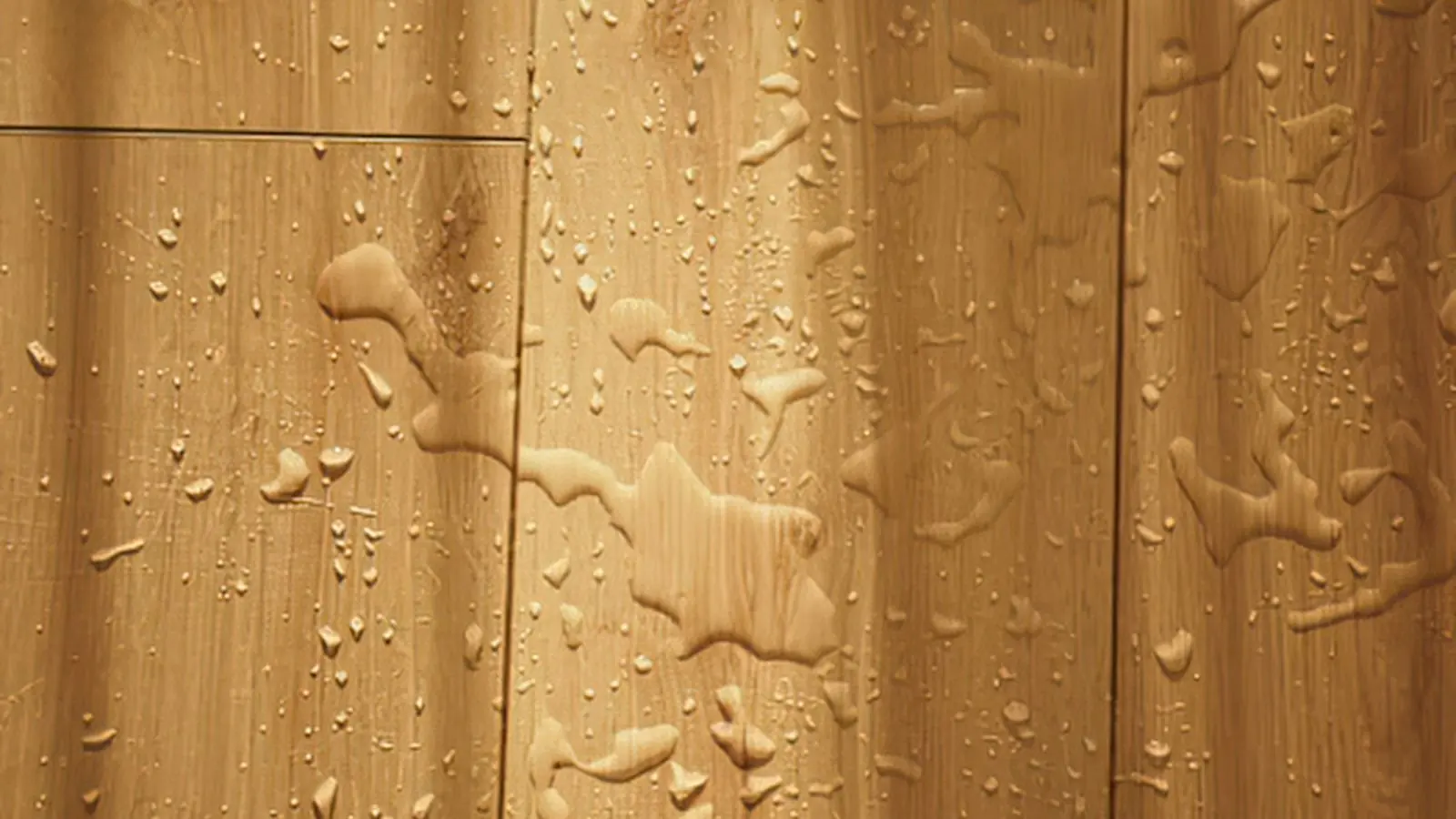
The first hour: stop the water and clear the surface
A wet wood floor is a race against absorption. Boards drink water from the top, the edges and the underside, and the longer they sit wet, the more they swell and the harder they are to flatten again. The goal for the first 48 hours is simple: stop the source, get the standing water off, and start drying before the boards lock into a new shape.
- Shut off the supply: the fixture valve, the washer valve, or the main shut-off.
- Stay out of water that touches outlets, power strips or a panel. Turn off breakers for wet rooms from a dry position, and for any electrical risk phone the utility or 911 before a restoration company.
- Soak up surface water with towels and a wet vacuum. A household dry vacuum is not made for water.
- Lift rugs, mats, boxes and furniture. Put foil or plastic blocks under the legs of anything you cannot move.
- Open the cabinet toe-kick and pull baseboard only if you can do it without damaging walls, so air reaches the edges.
Take photos before you move things, and keep a log of what you did and when. If you are unsure the water is clean, such as a toilet overflow or anything from outside, keep people and pets out and treat it as contaminated. Our emergency water removal crews handle extraction when there is more water than towels can handle.
How a wet wood floor gets dried
Fans pointed at the floor are not enough. Wood holds water deep in the fibers, and the cavity below the boards stays wet long after the top feels dry. Professional drying works on both sides of the floor at once.
A subfloor mat system lays drying mats over the boards, and a vacuum pulls moisture out through the seams. Air movers push dry air across the surface, and LGR dehumidifiers pull the moisture out of the room so it does not just move somewhere else. Crews take moisture meter readings in the same spots every day, and the numbers decide when drying stops.
Drying is part of the larger process of water mitigation. Ask any company if its crews work to ANSI/IICRC S500, and ask to see the daily readings. Those logs are also what an insurer may want to see.
Water still spreading? The emergency line is open 24 hours a day.
Call (760) 769-1159Cupping, crowning and buckling: what the board is telling you
Boards change shape as moisture moves through them. Cupping means the edges rise above the center, and it usually follows moisture from below. Crowning is the reverse, with the center higher than the edges, and it often shows after a cupped floor was sanded too early or after water sat on top. Buckling is the worst: boards lift off the subfloor, sometimes in a ridge.
| Symptom | Likely cause | Next step |
|---|---|---|
| Edges higher than center (cupping) | Moisture below the boards, such as a slab, crawl space or leak under the floor | Find and fix the source, dry the cavity, and recheck after drying |
| Center higher than edges (crowning) | Surface water, or a cupped floor sanded before it dried | Keep drying, do not sand, and let readings settle |
| Boards lifting off the subfloor (buckling) | Heavy or long exposure to water | Stop foot traffic and call for an assessment, since boards often need to come out |
| Dark stains or black lines between boards | Water sat long enough to stain the wood or finish | Have the area checked for moisture and for any growth on the underside |
| Floor feels soft or springy | Subfloor underneath is saturated | Dry it out promptly and check the subfloor with a meter |
What the moisture meter tells you, and why you do not sand yet
A moisture meter reading means little alone. Compare it with a dry board from an unaffected room or the same floor in a closet, and watch whether the number is falling each day. A pin meter reads the wood itself, and a pinless meter scans a wider patch without leaving holes.
Do not sand or refinish while the wood is still wet. Sanding takes off the cup you can see, but the wood is still wet below. When it dries, the boards shrink and the floor goes flat in the middle and gaps open at the seams. Finish also fails to bond to damp wood, and trapped moisture can cloud or lift it.
Wait until readings match the dry reference and stop moving across several visits. Only then does the real repair decision start, and water damage repair covers sanding, board replacement and refinishing once the floor is stable.
Slab or raised floor: why the structure underneath matters
Wood on a concrete slab dries differently from wood on a raised wood floor with a crawl space. A slab can hold moisture and release it upward for weeks, and wood placed directly on it may need a moisture barrier check before any new floor goes down. A raised floor has an air space that can be ventilated and dried, but insulation and subfloor can hold water that you cannot see.
Either way, the answer is the same: find where the water went, not only where it landed. A meter, a thermal camera and a few small checks along walls and cabinets usually show the path. If water reached the walls, drying often continues into the wall cavity too.
Cathedral City note: washer valves, supply lines and AC drains
The most common ways water reaches a wood floor are plain household failures. A washer supply valve that breaks loose, a dishwasher supply line that splits behind the unit, or a refrigerator ice-maker line that drips for days can all soak the boards from the side. Pull the appliance out and check the line before you decide it was a one-off.
In Cathedral City, where mean July highs reach about 107.6 F, AC systems run hard and condensate drain lines clog or overflow. A drain pan that spills near a wall can wick into baseboard and the edge of a wood floor, so look at any wood that sits near the air handler or a hallway closet.
If the damage ends up including new flooring as part of a bigger repair, ask the city Building and Safety Division at 68700 Avenida Lalo Guerrero if your repair needs a permit. A plain dry-and-refinish job may not involve one, but the city is the right place to ask. We serve nearby neighbors in Palm Desert and Thousand Palms with the same drying approach.
Frequently asked questions
Can I save a wood floor that was wet for a few days?
Sometimes. Boards that have only cupped slightly often flatten once dried properly, and it depends on how long they stayed wet, what the water was, and what lies underneath. A moisture check shows whether drying is still working.
Should I use a heater or a hair dryer to speed things up?
No. Fast, uneven heat can crack boards and pull the finish. Controlled air movement with dehumidification dries the wood at a steadier pace.
How long does a wood floor take to dry?
It depends on the type of wood, the amount of water and the drying setup. Days is typical for equipment-based drying, and the readings, not the calendar, tell you when it is done.
Does insurance cover a flooded wood floor in Cathedral City?
Insurers usually separate a sudden appliance failure from a slow leak and from a flood. Check your policy, report the damage quickly, take temporary steps to protect the floor, and keep drying logs and photos.
A burst washer hose soaked my wood floor in Cathedral City. Do I need to pull the floor right away?
Not always. Shut off the water, get the surface water extracted, and start drying first. The floor is pulled only when readings or buckling show it cannot be dried, and that decision is best made after a meter check.